On a quiet Sunday morning in Hawaii, history was violently rewritten.
On December 7, 1941, the United States was drawn into a global conflict that would reshape not only the nation, but the entire world. The attack on Pearl Harbor was sudden, devastating, and unforgettable — and its impact still echoes across generations.
Today, Pearl Harbor is preserved as a National Historical Park, and the USS Arizona Memorial stands as one of the most powerful war memorials anywhere in the world. But to truly understand why this place matters so deeply, we must understand what happened, why it mattered, and why it continues to be remembered.
What Was Pearl Harbor?
Pearl Harbor is a natural harbor located on the island of Oahu, Hawaii, and it has long been of strategic importance. Before World War II, it served as the primary base of the United States Pacific Fleet.
At the time, Hawaii was still a U.S. territory, not yet a state. Pearl Harbor symbolized America’s military presence in the Pacific — and for Japan, it represented a perceived obstacle to their expansion across Asia and the Pacific.
The Morning of December 7, 1941
Shortly before 8:00 AM on Sunday, December 7, Japanese aircraft launched a surprise attack on Pearl Harbor.
In just under two hours, the attack resulted in:
- Over 2,400 Americans killed
- More than 1,100 wounded
- Eight battleships damaged or destroyed
- Hundreds of aircraft destroyed
- Massive loss of life aboard ships docked in the harbor
The attack was not preceded by a declaration of war. For many Americans, it was a complete shock — a moment when the sense of safety and distance from global conflict vanished instantly.
President Franklin D. Roosevelt would later describe it as “a date which will live in infamy.”
Why Japan Attacked Pearl Harbor
Japan’s goal was strategic.
By attacking Pearl Harbor, Japan hoped to:
- Cripple the U.S. Pacific Fleet
- Prevent American interference in their military campaigns
- Gain dominance in the Pacific region
While the attack caused immense destruction, it failed to achieve its long-term objective. Critical American assets — including aircraft carriers — were not present in the harbor at the time.
Instead of weakening American resolve, the attack united the United States like never before.
How Pearl Harbor Changed the United States
The attack on Pearl Harbor marked a turning point in American history.
1. The U.S. Entered World War II
On December 8, 1941, the United States formally declared war on Japan. Within days, Germany and Italy declared war on the United States, pulling America fully into World War II.
This decision transformed the U.S. from a nation attempting neutrality into a global military power.
2. A Nation United
Pearl Harbor erased political divisions almost overnight. Americans from all backgrounds united behind the war effort.
- Millions enlisted or were drafted
- Industries shifted to wartime production
- Communities rallied to support troops overseas
The phrase “Remember Pearl Harbor” became a national rallying cry.
3. America’s Role in the Modern World
The war that followed reshaped global politics. By its end, the United States emerged as one of the world’s leading superpowers — a role it still holds today.
In many ways, modern American history begins at Pearl Harbor.
The USS Arizona: A Symbol of Sacrifice
One of the most tragic losses during the attack was the USS Arizona.
At 8:06 AM, a Japanese bomb struck the battleship, detonating its forward ammunition magazine. The explosion was catastrophic.
- 1,177 sailors and Marines were killed
- The ship sank in minutes
- Most crew members were trapped below deck
The USS Arizona was never salvaged. Instead, it remains submerged beneath the waters of Pearl Harbor — a permanent resting place for those who lost their lives.
Why the USS Arizona Memorial Exists
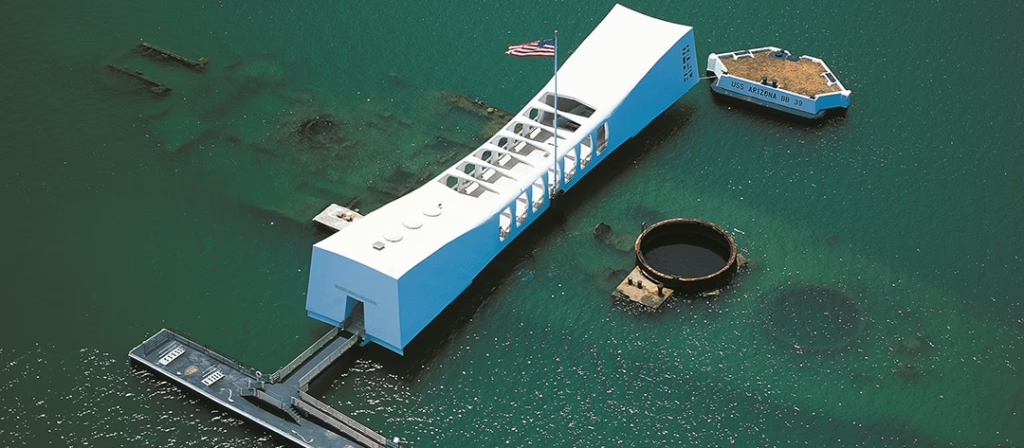
The USS Arizona Memorial was built to honor those who died aboard the ship and to serve as a place of reflection for future generations.
Completed in 1962, the memorial:
- Spans the sunken remains of the USS Arizona
- Allows visitors to look down into the harbor
- Marks the final resting place of over 900 sailors
Many survivors chose to have their ashes interred with their fallen shipmates — a testament to the bond forged through service and sacrifice.
The memorial is not just about the past. It is a reminder of the cost of war and the value of peace.
Pearl Harbor as a National Historical Park
Pearl Harbor is officially designated as a National Historical Park to ensure that the events of December 7, 1941, are never forgotten.
The park preserves multiple sites, including:
- USS Arizona Memorial
- Battleship Missouri
- USS Bowfin Submarine
- Pacific Fleet Submarine Museum
Together, these sites tell the story of attack, sacrifice, response, and victory — from the beginning of America’s involvement in World War II to its conclusion.
Why Pearl Harbor Still Matters Today
More than 80 years later, Pearl Harbor remains deeply relevant.
A Living Memorial
Pearl Harbor is not a static monument. It is a living place of remembrance, visited by millions each year from around the world. Thousands of visitors pay their respects every day when they take the boat ride over to the USS Arizona Memorial. Tickets to the USS Arizona Memorial are sometimes hard to get, so make sure to make your reservation ahead of time!
Every morning, the National Anthem is played at 8:00 AM, creating a moment of quiet reflection that connects past and present.
Education for Future Generations
Preserving Pearl Harbor ensures that future generations understand:
- The consequences of war
- The importance of vigilance
- The value of diplomacy and peace
It is a place where history is not just learned — it is felt.
December 7: A Day of Remembrance
Each year on December 7, Pearl Harbor hosts remembrance ceremonies honoring those who lost their lives.
While the memorial remains open, the day operates differently, with:
- Special ceremonies
- Military presence
- Increased security
- A powerful, emotional atmosphere
Visiting Pearl Harbor on December 7 is a profound experience — one that many consider an honor rather than a typical tour.
Final Thoughts: Remembering Pearl Harbor
The attack on Pearl Harbor was more than a military strike. It was a moment that changed the course of history and redefined America’s role in the world.
The Pearl Harbor National Historical Park and the USS Arizona Memorial exist so that we never forget the cost of freedom, the sacrifice of those who served, and the importance of remembrance. Visit Pearl Harbor National Park and the USS Arizona Memorial on your vacation in Hawaii.
Standing above the sunken USS Arizona, watching oil droplets rise to the surface — often called the ship’s “tears” — visitors are reminded that history is not distant.
It is present.
It is personal.
And it matters.